


The Fermi Paradox - Where are the Aliens?, by Professor Ian Crawford

The evening opened with a short members’ talk (full disclosure, dear reader: it was me!) describing a summer project to build a home observatory. This semi-remote-controlled imaging observatory had been many years in the planning, and finally came together over the spring and summer. In this short overview I discussed the rationale, design, and build of the observatory - watch this space for a potential follow-up workshop for anyone interested in the technical details.
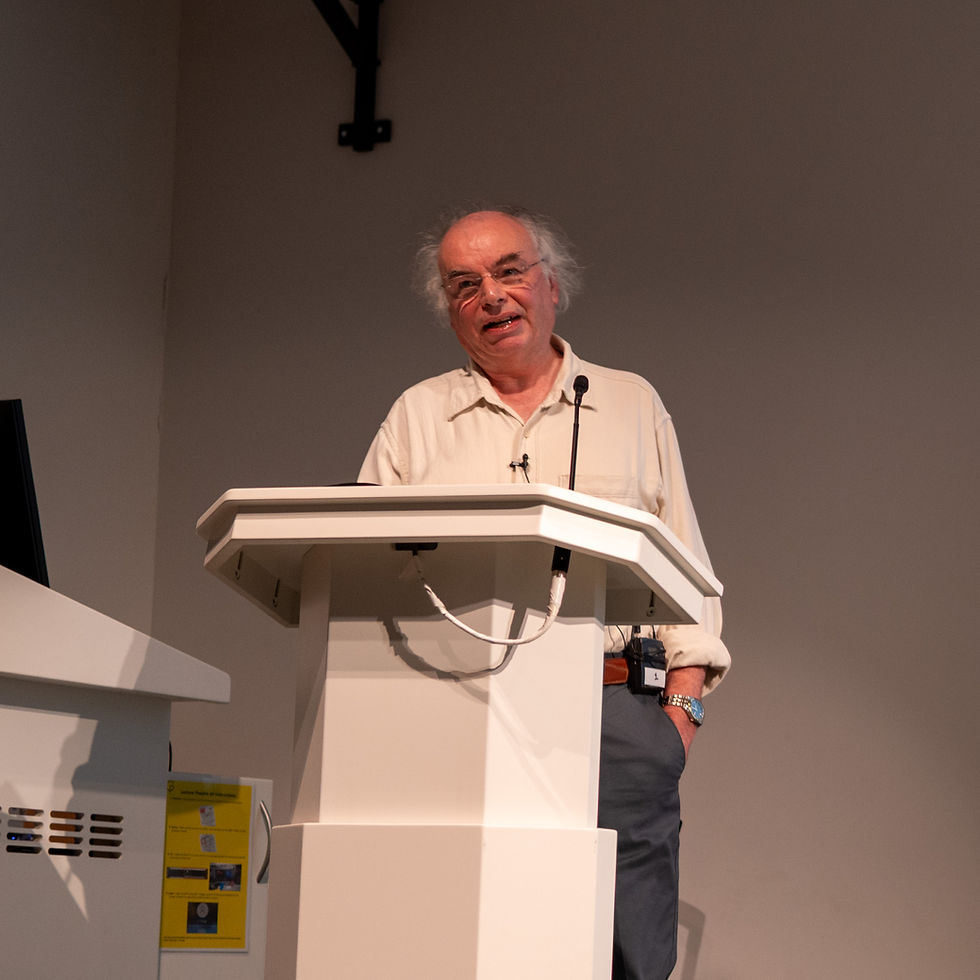
Simon, our host for the evening, then introduced our main speaker, Professor Ian Crawford (Birkbeck College, University of London), who talked to us about the Fermi Paradox. This name comes from the late physicist Enrico Fermi, who postulated the question in 1950: “Where is everybody?”. Fermi was referring to the conundrum that, given the huge number of stars in the known galaxy, and hence planets orbiting around these stars (including from recent direct observation), why is there such a profound lack of evidence of advanced extra-terrestrial life?
Ian deftly took us through the various arguments, starting out with a thought experiment: even at very attainable sub-light speeds, the entire Milky Way galaxy could be crossed in a few million years. Given the vast number of stars, and therefore civilisation-hosting planets that may have developed advanced technology during this time, and that a large proportion of extra-solar systems are billions of years old, why is there no evidence of “visitors”? There are many counter arguments of course. Advanced extra-terrestrial civilisations may simply not exist, and the Earth is unique. Or they may have developed some form of ethical standard not to interfere in other developing worlds, rather like the “Prime Directive” in the Star Trek television series. Or perhaps we are all just an experiment by Andromedans, or participating in The Matrix?
Science fiction aside, the fact remains that the development of advanced multicellular life occurred over a very long time. Examination of the geological record on Earth shows that the evolution from single-cell to multicellular life took some 2 billion years, and to vertebrates another 1.5 billion. Hominins, and the technology for exploration, have only developed recently over the last 1 million years. So perhaps this is the bottleneck, if this development timescale is similar to other advanced extra-terrestrial species? However, given the lack of evidence to the contrary, it would seem that our lone Type G star and its suite of planets represents a unique scenario whereby life has developed to its present point on Earth, safely located in the habitable zone. A fascinating paradox, and one for the philosophers in the society to ponder for a long time to come.


Comments