


Eyes at the Eyepiece: Jupiter, the Moon and a Night for Visual Observing - Blackheath Observing, Sunday 22 February 2026

I arrived at around 5.45pm in the hope of spotting Mercury low in the west, but low cloud over central London put an end to that idea. No matter - it gave me time to catch up with Alec, who had also arrived early, and to compare notes on the prospects for the evening. We reminded ourselves that this was the first Blackheath observing session since 13 December. Such has been the weather over the past couple of months that sustained clear skies have been in very short supply.
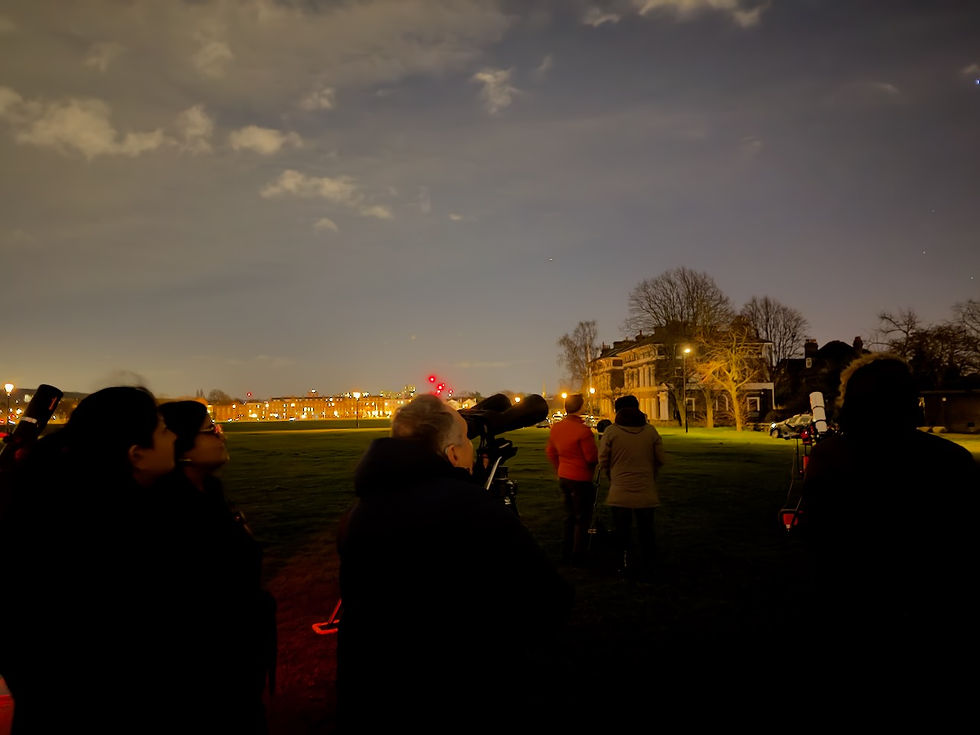
Conditions were far from perfect, but the main cloud banks stayed further north than forecast. Although there were interruptions during the evening, gaps continually opened across the sky, and there was always something worth pointing a telescope at.
Far from perfect conditions, but plenty of breaks in the cloud cover. Pictures by Mike Meynell
We began with the Moon, about 30% illuminated and hanging in the south-west. Even at low magnification it was striking, but higher magnification revealed astonishing detail. Despite the gusty wind, periods of calm brought moments of very steady seeing. The terminator region was superb, with Theophilus, Cyrillus and Catharina showing remarkable relief and detail across their floors.
A couple of dog walkers stopped to ask what we were looking at and were persuaded to take a look. Their reaction said everything - the view was enough to stop anyone in their tracks.
Checking my lunar map, I realised the Apollo 11 landing site lay close to the terminator, so Alec and I decided to try for Armstrong Crater. At just over 4 km across, it sits right on the edge of what can be detected visually with a 100 mm refractor. I had imaged it before but never seen it at the eyepiece. The neighbouring Aldrin and Collins craters are smaller still and beyond realistic visual detection. Alec spotted Armstrong first: not a clean crater form, but a tiny pit-like speck that appeared and vanished with the seeing. Even so, seeing it from London with modest aperture felt like a small triumph.
Tony was busy with his mounted binoculars and tracked down M41, sometimes nicknamed the “little Beehive”. It took patience to pick out, but once found it was a pleasing sight. M44, the actual Beehive Cluster, was much easier, and Hayden added handheld stabilised binocular views, offering visitors a different way to explore the sky.
The smart telescopes struggled in the gusty wind, reminding us that traditional observing still has its place. Sara imaged several targets with her Seestar S30, while Richard wrestled initially with his S50 locating the Moon - a common quirk - before getting it working reliably. Les, Brendan and others added to the mix of equipment on display.
A night for visual observing... traditional telescopes and binoculars. Pictures by Alec Knox and Mike Meynell.
Attention then turned to Jupiter, which delivered an evening of rare dynamism. Early views showed excellent surface detail, with Io, Europa and Callisto clearly visible. We were anticipating Io’s shadow transit later in the evening, but first came an unexpected highlight: the emergence of Ganymede from eclipse.
This is one of those moments that can only be witnessed at the eyepiece. Alec and I stayed glued to our scopes around 7.12pm. A faint point slowly materialised from the darkness beside Jupiter, brightening over about a minute before taking its place between Io and Europa. It was a beautiful demonstration of celestial mechanics in real time.
Io soon disappeared as it crossed the planet’s disc. At 8.45pm, right on cue, a small “bite” appeared on Jupiter’s limb as Io’s shadow began its journey across the cloud tops. It was subtle at first, but a queue quickly formed and everyone managed to see the tiny black dot with a little guidance.
Over the next hour we tracked the shadow’s progress. Many began packing up as the wind strengthened and the chill set in, particularly affecting the smart scopes. I stayed on to see Io reappear. At 10.02pm, a tiny bright “pimple” emerged on the opposite limb and slowly separated from the planet. Another beautiful moment.
That felt like the natural end to the session. Hayden produced some liquid refreshment - memorably described by Alec as “rum with a dash of chocolate” - and we drifted off home.
A memorable evening: great company, relaxed conversations, and the pleasure of sharing the sky with newcomers discovering it for the first time.
We plan to do it all again on Saturday 14 March.


Comments