


Ring of Fire: Chronicles of Eddington and Chandrasekhar, by Bobby Manoo

Updated: May 16
As the Flamsteed Astronomy Society’s current ‘History of Astronomy’ season draws to a close, we were presented with an enthralling talk given by our Chairman Bobby Manoo. A near-capacity audience in the main auditorium of the National Maritime Museum were treated to an exposition of one of the most famous and consequential disputes in twentieth-century astrophysics: the clash between Sir Arthur Eddington and Subrahmanyan Chandrasekhar, over the theory that ultimately became known as the ‘Chandrasekhar Limit’.
The evening combined astrophysics, biography, philosophy, and archival historical research to reconstruct not only the scientific disagreement itself, but also the personalities, pressures, and worldviews that shaped it. Bobby aimed to take the audience beyond the simplified modern retellings out on the internet, and instead to examine the dispute through surviving records, correspondence, and historical context.
The talk began with an accessible overview of stellar evolution and compact objects. We were guided through the life cycle of stars, from protostars through to red giants, white dwarfs, neutron stars, and black holes. Central to this explanation was the balance between gravity pulling matter inward and the outward pressure generated by nuclear fusion. When fusion ends, white dwarfs are sustained instead by electron degeneracy pressure.

From this foundation, Bobby introduced the Chandrasekhar Limit - approximately 1.4 solar masses - the threshold beyond which a white dwarf can no longer support itself against gravitational collapse. Above this limit, collapse continues toward the formation of neutron stars or black holes. Bobby emphasised that this limit underpins much of modern astrophysics and forms the theoretical basis for our understanding of compact stellar remnants and relativistic collapse.
The narrative then moved into the scientific atmosphere of the 1920s and 1930s, when relativity and quantum mechanics were beginning to transform astrophysics. Physicists including Ralph Fowler, Arnold Sommerfeld, Paul Dirac, and Wolfgang Pauli were all contributing pieces to the puzzle of stellar structure and electron degeneracy.
A substantial section focused on Sir Arthur Eddington, who at the time was regarded as the dominant authority on stellar astrophysics. His confirmation of Einstein’s relativity during the 1919 eclipse expedition had made him internationally famous, while his book The Internal Constitution of the Stars became the defining text on stellar structure. Bobby explored Eddington’s Quaker upbringing and philosophical belief in a harmonious and ordered universe, arguing that these ideas profoundly shaped his scientific thinking. Eddington could not easily accept the notion that stars might collapse into extreme compact objects or singularities, as such outcomes conflicted with his vision of cosmic order.
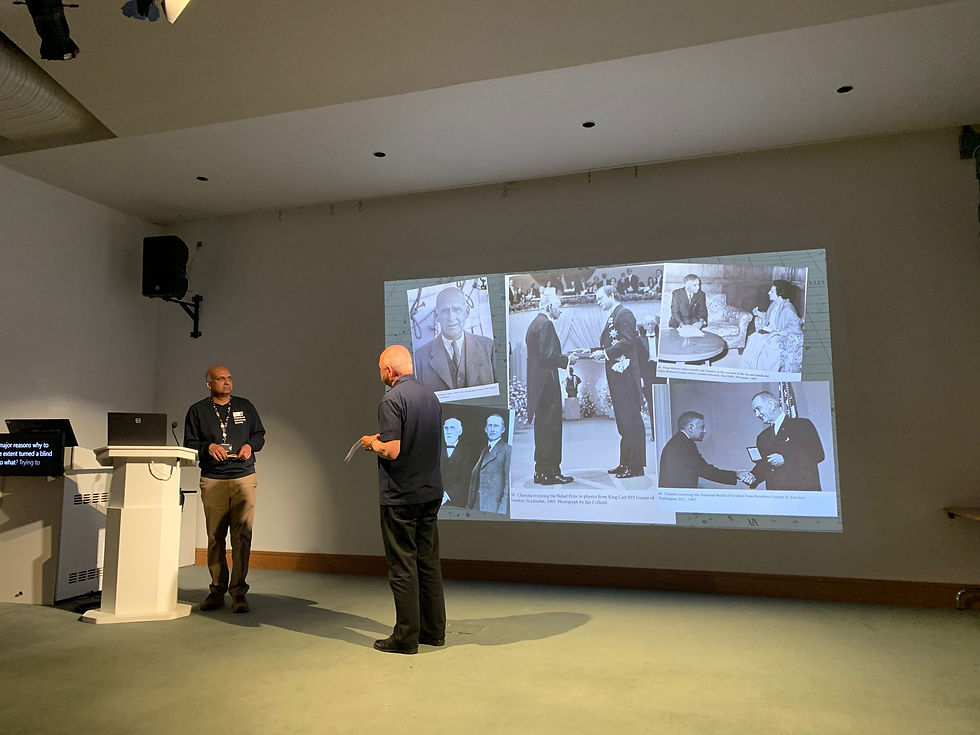
Bobby during his talk to the Flamsteed. Pictures by Amy Scammell.
We were then introduced to Chandrasekhar’s early life in Imperial British India, his mathematically gifted background, and the influence of his uncle, Nobel laureate C. V. Raman. Inspired by a lecture tour in India by Sommerfeld, Chandrasekhar immersed himself in theoretical astrophysics and later travelled to Cambridge, England, on a government scholarship. During his long sea voyage from India in 1930, he worked intensively on combining relativity with quantum statistics, ultimately deriving the limiting mass for white dwarfs.
The centrepiece of the evening’s talk focused on the dramatic events surrounding the 11th January 1935 meeting at the Royal Astronomical Society. By this stage, Chandrasekhar had spent the years refining his calculations under the supervision of leading physicists, including Eddington himself. He had carefully consulted experts in relativity, quantum theory, and stellar structure to ensure that his mathematics was sound.
Bobby described how Eddington had personally encouraged Chandrasekhar to present his research to the Royal Astronomical Society and had even arranged additional speaking time for him. However, on the eve of the meeting, Chandrasekhar learned that Eddington intended to deliver a paper immediately afterwards on relativistic degeneracy - something Eddington had never previously mentioned in their many discussions.
The meeting itself was described as packed with many of Britain’s leading astrophysicists in attendance. Chandrasekhar presented his paper, The Highly Collapsed Configurations of a Stellar Mass, outlining the mathematical inevitability of a limiting stellar mass beyond which collapse must continue.
We were told how Eddington’s response was devastatingly public and theatrical. Rejecting the conclusions of Chandrasekhar’s work, he argued that there “should be a law of nature” preventing stars from behaving in such an “absurd” way. He attacked the implications of relativistic degeneracy theory and ridiculed the idea of continued gravitational collapse. Importantly, Bobby stressed that Eddington did not directly refute Chandrasekhar’s mathematics. Instead, he rejected the physical and philosophical consequences of those calculations.
We heard how Eddington’s immense authority in astrophysics shaped the reaction in the room. Although some physicists privately supported Chandrasekhar’s work, few were prepared to publicly challenge Eddington. Chandrasekhar himself was reportedly denied the opportunity to reply after Eddington’s remarks. Bobby described the episode as leaving Chandrasekhar “intellectually vindicated but professionally isolated.”
Bobby’s talk also explored the human side of the conflict. Chandrasekhar experienced intense loneliness and pressure as a young Indian scholar in Britain, while Eddington himself was portrayed as deeply isolated and emotionally reserved. Despite the fierce public disagreement, the two men continued to interact socially and professionally for several years afterwards. Later in life, Chandrasekhar acknowledged Eddington’s immense contributions to astrophysics and even wrote a book praising him as “the most distinguished astrophysicist of his time.”
The final section of the talk followed the eventual triumph of Chandrasekhar’s theory. Later generations of astrophysicists, including Roger Penrose, Stephen Hawking, and Carl Sagan, built upon the foundations laid by Chandrasekhar’s work. His contributions were recognised with the 1983 Nobel Prize in Physics, while the NASA Chandra X-ray Observatory stands as a lasting tribute to his legacy.
A few questions from the audience followed, exploring Eddington’s religious and philosophical beliefs, the origins of black hole theory, whether Eddington’s opposition harmed his later reputation, and why he chose public confrontation rather than private criticism. Bobby suggested that Eddington was deeply uncomfortable with direct personal conflict, and instead expressed disagreement through formal public forums.
The evening presented far more than a scientific history lesson. It became a compelling exploration of how science progresses through not only mathematics and observation, but also personality, philosophy, authority, and human vulnerability. In the end, the story of Eddington and Chandrasekhar stood as both a cautionary tale about scientific certainty and a powerful testament to intellectual resilience.
The story is not over, as Bobby continues his investigations into these two titans of astrophysics. Appropriately, we can say: ‘Watch this space’…


Comments