


Easter, Planets and a Fairground on the Horizon – Blackheath Observing, 5 April 2026

A very enjoyable evening of observing on Blackheath, even if we were effectively competing with a circus and a fairground for the local sky.
Being Easter Sunday, there was a certain sugar-fuelled momentum to the proceedings; it was suspected that a fair amount of chocolate had been accounted for before our visitors made their way onto the heath! We had around 70 visitors, mostly over a fairly busy hour or so, and well over a dozen scopes set up.
Conditions turned out pretty much as forecast. A bit breezy with some high haze early on, but both dropped away as the evening went on. By the end it was near still, with clear skies.
Jupiter and Venus
Eddie focused on Venus, while I made Jupiter my main target, and we moved visitors between the two.
Venus, at around 93% illumination, got a strong reaction - especially from those seeing the phase for the first time.
But, as usual, Jupiter was the main draw. All four Galilean moons were obvious, and the north and south equatorial belts were very easy to pick out. As the sky darkened, more detail came through across the disc.
We spent quite a bit of time talking about how Jupiter’s appearance changes over time - particularly the belts and the Great Red Spot. We just missed the Red Spot before it rotated out of view, but there was still plenty to see.
Around the heath
Alec was experimenting with a fairly minimal imaging setup – an iPhone with a telephoto lens attachment on a tracking mount. Results were, to paraphrase his words, “mixed”, and will need a bit more work before they’re worth sharing. The main issue was light spill from the fair and circus, causing reflections off the front UV filter, along with a strong gradient from the general light pollution. Both are fixable next time – flats would help.
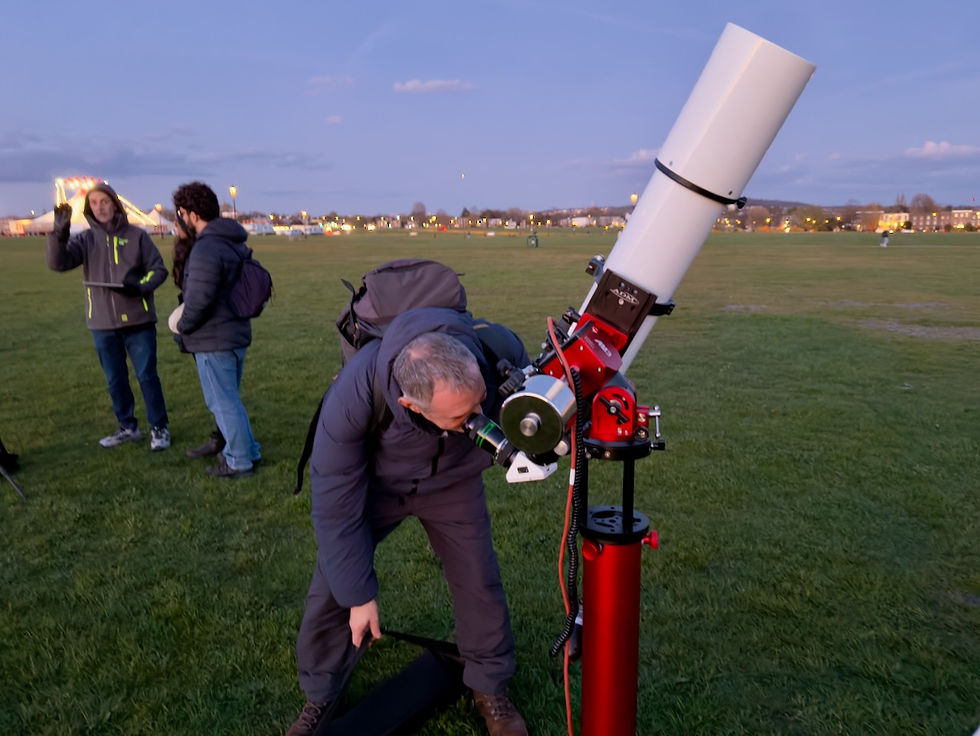
A busy night on Blackheath, with our observing session, and the fair and circus as a backdrop. Pictures by Mike Meynell.
He also noted how enthusiastic the visitors were across all age groups, which led to some good conversations about stellar distances - and the inevitable question of why we can’t see Artemis 2 heading off to the Moon. The simple answer being that, beyond Earth orbit, spacecraft are just too small and too distant to be visible.
The rise of the machines
The "Smart Telescope" revolution was out in force. Sara and Yvonne spent a good portion of the night acting as unofficial product demonstrators, fielding questions about cost, portability, and whether these devices signal the end of actually needing to know where anything is. Quite a few visitors were moving between their two setups, presumably weighing up their options for future birthdays.
Richard shared images of Jupiter, M42, M84 and M51, initially describing them, with some understatement, as “a little underwhelming”. He later noted that he might have been a bit harsh on them, having overlooked the Seestar’s built-in denoising before uploading.
Lots of images from the Smart Telescopes. Pictures by Yvonne Jacobs, Richard Summerfield and Sara Clark.
Adrian had a more frustrating night. The combination of wind, light pollution and a recent software update to the Vespera Pro made alignment difficult and resulted in a lot of rejected frames. After a long session, the result on the Jellyfish Nebula wasn’t great, but it sounds like there’s more testing to come.
Fireworks… and the end of the night
At 9:45pm, the Old Royal Naval College decided to contribute to the light pollution by launching a large firework display to our north. It looked great, even if it wasn’t entirely helpful from an observing point of view.
By the end of the evening, a small group of us - Alec, Yvonne, Eddie, Tony and myself - were still there, putting the world to rights before heading off home.
All in all, a very enjoyable session. Good turnout, improving conditions, and plenty to see.
We do it all again next weekend (11 or 12 April) for our final Blackheath observing session of the 2025/26 season.


Comments