


RMG Members' Solar-Viewing Session - Thursday 6 August 2026

Updated: Aug 7
Flamsteed and RMG held a members’ solar-viewing session on Thursday evening, splitting the evening into two group sessions. I hadn’t realised that I was supposed to be in the second group and ended up gatecrashing the first... shhh, don’t tell anyone!
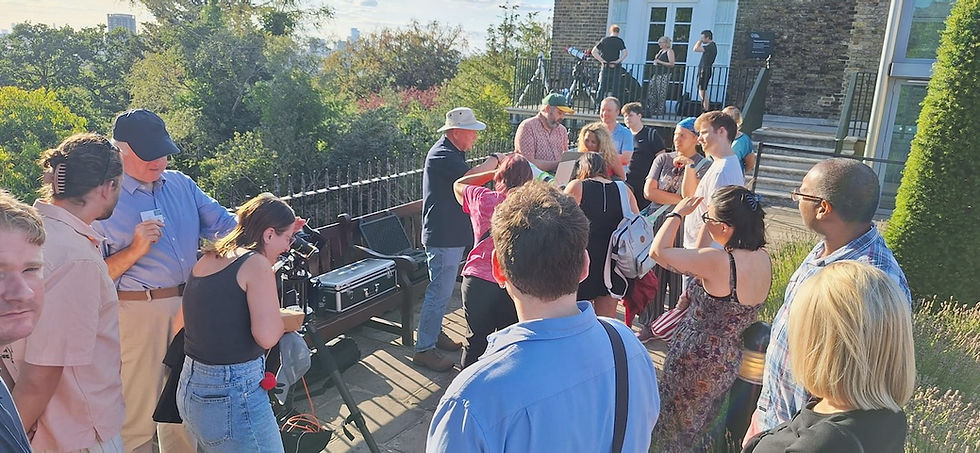
Mike Meynell, organiser and host of this evening’s session, gave us a quick introduction to the several scopes that were set up in the garden beside Flamsteed House and the Meridian Building, each observing the Sun in different ways and at different wavelengths. Then we were set free to tour each solar-observing terminal in any order. Most of us roamed in a natural clockwise direction, queueing at each terminal on the way, so the smarter members went straight to the end, going anticlockwise for fast-track views!
Two groups of RMG members in attendance. Pictures by Tej Dyal.
First up was a curious terminal that had a big box with some poor fella’s head stuck in it. As we approached to help this poor soul, out popped his head, which belonged to Tim, a Flamsteed stalwart volunteer and solar wizard. The wizard beckoned each of us to plug our head into the box, one at a time. As we did so, nervously, we realised that inside the box was a laptop, with the box, of course, shielding it from the glare of daylight. On the laptop screen was a glorious live black-and-white image of the Sun in Calcium K. What was so striking about this view was that there were so many bright patches, which Tim explained are called plages - hotter regions than the rest of the Sun. I noticed that some of the plages had sunspots (cooler regions), but most did not. I found this curious, as I had thought that plages always went hand in hand with sunspots, creating a convection of hot and cold. Of course, the eternally knowledgeable wizard had an answer. He explained that I was right to expect that, but to think of a plage as a storm and the sunspot as the eye of the storm. As a storm builds, the eye of the storm forms some time afterwards, and as a storm subsides, so does the eye, but the storm still lingers for a long time afterwards. So, the plages without sunspots will at some point have a sunspot or have already had one. Thank you, Tim, for a great explanation.

We then moved on to another completely odd-looking contraption, which looked like three planks of wood glued together into a triangle, with cut-outs for glass and mirrors. Hosting this low-budget-looking device was Ed, enthusiastically shifting this wooden device, called a Sunspotter, until suddenly the Sun was projected onto a white panel inside it. What we could see was a solid white disc with some sunspots in view. For a cheap contraption, I thought this was quite amazing. Maybe we can make one ourselves, so I asked Ed how we could make one and how many pennies it would cost. He answered 60,000 pennies. What?! That’s £600! Furthermore, no one makes them anymore. Still, it’s a fascinating device and seems more precious than I realised.

Next to the Sunspotter was a robot that looked like Wall-E. Controlling Wall-E remotely was Yvonne, a self-confessed solar obsessive, and Wall-E was actually a latest-generation smart scope, the Dwarf 3, focused on the Sun and stacking live images, which Yvonne showed us on her mobile phone screen. This view of the Sun was in white light, which brings out the sunspots in vivid clarity. I asked Yvonne to zoom in on the sunspots and noticed that one of the larger ones was a cluster of sunspots. Quite amazing detail. But Yvonne looked a bit sad. She has seen the Sun flaunting many more sunspots on other days (being the obsessive that she is) and had hoped to show us that, but I told her it was OK. Seeing even just one sunspot in such detail, revealing it to be a cluster, was more amazing than seeing many singular sunspots. It truly was.
But up to that point, I had been looking at flat, live-feed images, and while I appreciated the glorious detail these smart scopes and traditional scopes with cameras attached provided, I hungered for more immersion... aside from the novelty of putting my head in a box. And so, we came to a couple of traditional eyepiece-viewing telescopes hosted by Alec and Clive. They were not quite traditional telescopes, however, but dedicated hydrogen-alpha solar scopes that filter everything else out of the spectrum, letting through only one single hydrogen emission wavelength on the red side of the spectrum. As we looked through the eyepiece, we saw that the Sun’s disc was red.
But what was revealed in this part of the spectrum was glorious! While sunspots were more hidden away in this view of the Sun, this was more than compensated for by the prominences (magnetic field storms spouting from the limb) and filaments (the same as prominences, but appearing as dark hairline fractures on the surface of the Sun). By Alec’s count, the Sun was sporting around 11 filaments. These filaments were huge and looked like many eyebrows, although one looked like a sine wave (alien communication?). Then there were the prominences - one looked like a garden hedge, while another, an absolute monster of a prominence, looked like a stretched-out monolith realising it was in the wrong place and trying to escape. Alec reckoned the monster prominence to be about 12 Earths in length.
The final stop was a telescope with various wires, tiny computers in 3D-printed bodies and other cobbled-together bits and bobs, all somehow steering and tracking the scope. This was hosted by DIY wizard Frederik, who was remotely controlling his scope with a tablet that showed views of the Sun, bringing out even more detail in the sunspots than the Dwarf 3 due to the scope having twice the aperture. Again, quite impressive detail in the sunspots.

And so, my gatecrashing session ended as the second group came in, the one I really belonged to... and so I joined them to have seconds... shhh, again, don’t tell anyone!
I wish to thank Mike Meynell for organising a fantastic session of solar observing for us members, and the Flamsteed volunteers Alec Knox, Clive Inglis, Ed Fosbrook, Frederik Botha, Tim Rickard and Yvonne Jacobs for entertaining us with eclectic views from their personal and the Museum’s solar-observing gear.
The Sun in different wavelengths. Tim's Calcium-K image, Frederik's H-Alpha image and Yvonne's white light image from the Seestar.
A few more images from the evening. Pictures by Ed Fosbrook and Yvonne Jacobs.


Comments