


Filaproms, Pucks and Calcium K - Solar Observing, Saturday 25 July 2026

Tim and I were the first to arrive at the Royal Observatory, shortly before the gates opened at 10am. With the rest of our volunteers following soon afterwards, we quickly collected the equipment from the stores and began setting up around the Dolphin Sundial.
We had the smaller gazebo this week, but that did not prove to be a major problem. Temperatures were expected to reach around 28°C, although a steady breeze throughout the day made conditions rather more comfortable than they might otherwise have been.
By 11am, the Observatory was already extremely busy. For a while, it looked as though we might be heading towards a record-breaking session, with queues stretching beyond the Dolphin Sundial almost as soon as we began observing.
Big queues early in our observing session. Pictures by Mike Meynell.
Visitor numbers then became rather unpredictable. One minute, we had long queues at every telescope; shortly afterwards, the area could be almost empty. Before anyone had much chance to relax, another large group would arrive. This sort of stop-start session can be difficult for volunteers, but everyone coped admirably with whatever was thrown at them.
By the end of the day, we estimated that around 500 visitors had viewed the Sun through our equipment.
Our main hydrogen-alpha telescopes were the 60mm Coronado and Clive’s 76mm Sky-Watcher Heliostar. Clive’s telescope once again excelled at showing surface detail, including a particularly impressive filaprom.

A filaprom is a single stream of plasma that appears as a dark filament while crossing the face of the Sun, but continues beyond the solar limb as a bright prominence. Several of our volunteers had not seen one before, so it became one of the highlights of the session.
Not that the Coronado disgraced itself. Despite being more than 20 years old, it continues to perform brilliantly. Two large prominences, close together on the solar limb, particularly caught the eye. One was very obvious, while the other was fainter but considerably larger. Both were relatively easy for most visitors to see.
There were also several sunspot groups spread across the solar equator. These were shown particularly well through our white-light equipment and on the image produced by Yvonne’s Seestar smart telescope. The Sunspotter was busy throughout the day, with the various sunspot groups easy to pick out in the projected image. Sara, Sue, Tim and John spent much of the session explaining the view to visitors, while Sara’s invitation to “touch the Sun” received regular use - and not only from Sara.
Sara explaining the image on the Sunspotter, and Yvonne's Seestar white light image of the solar disc. Pictures by Mike Meynell and Yvonne Jacobs.
Tim brought along his Calcium K telescope and imaging set-up, which provided another excellent addition to our range of solar views. The live image on his laptop revealed the Sun’s active regions in remarkable detail and proved very popular with visitors and volunteers alike.
As Frederik commented afterwards, it was a great way to demonstrate how much the appearance of the Sun changes when viewed through different telescopes and filters. Tim later produced an excellent Calcium K image from the session, which can be seen below.
Tim's Calcium K rig, and one of his images taken during the session. Pictures by Mike Meynell and Tim Rickard.
Elsewhere, we were also trialling a new stand designed and 3D printed by Frederik for Yvonne’s Solargraph pucks. These record the movement of the Sun across the sky during a long exposure.
The stand can hold up to five pucks, positioned at different angles. Two were used during this session, one angled to the left and the other to the right, with both exposed for the full five hours from 11am until 4pm.
The stand itself worked very well. Its name remains less certain.
Suggestions during the day included the Puck Norris Solar Stand, the Crap Christmas Tree and the Toilet Brush Holder. A more respectable name may be required before its next public appearance, although Puck Norris appears to have taken an early lead.
The two resulting Solargraph images were very encouraging and showed that the stand had done its job.
The, as yet, unnamed solar puck stand and resultant images for the two attached pucks. Pictures by Yvonne Jacobs.
Our volunteers swapped between the equipment effortlessly throughout the day. I concentrated mainly on managing the queues, along with spending some time speaking to visitors about what they were about to see and explaining the different methods we use to observe the Sun safely.
As ever, the Time Ball provided a useful diversion in the minutes leading up to 1pm. It also gave the volunteers a brief opportunity to point in another direction.
The Time Ball in operation with queues forming at the scopes not long after the "show". Picutes by Yvonne Jacobs and Frederik Botha.
The skies remained clear for around 90 per cent of the session. There was a little occasional cloud early on, with more beginning to build towards the end of the afternoon, but it never caused us any significant problems. We were therefore able to continue right through until 4pm and complete a full session.
Huge thanks to Frederik, Sara, John, Clive, Yvonne, Alec, Tony, Sue and Tim for all their help. It was a hot and demanding day, but everyone worked extremely hard and helped hundreds of visitors enjoy safe views of a very active Sun.
A couple of volunteers had to leave before the group photograph was taken, so unfortunately not everyone who helped is pictured.
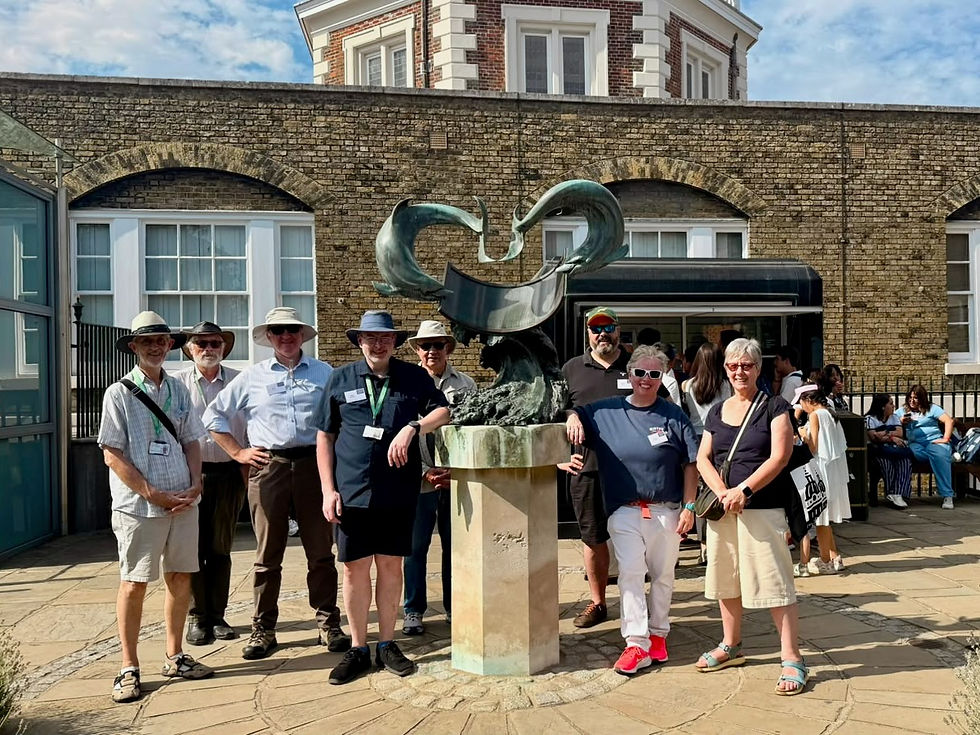
We were also missing two of our regular volunteers, Richard and Simon, and hope to see them back with us soon.
Our solar programme now moves up another gear. We return to weekly sessions for the remainder of the season, beginning on Friday 31 July, with Saturday 1 August as the weather back-up.
We also have the partial solar eclipse on 12 August and another evening session for Royal Museums Greenwich members. It is going to be relentless, but fortunately we have an excellent group of volunteers to help us through it.


Comments